Your Questions
Your Questions
Q: Dr. Eppley, I wanted to reach out given your extensive experience with lip surgery and see if I would be a good candidate for a procedure that I have had in mind for a while. I have a thin upper lift with a bit of a blurry vermillion border, which makes the lift procedure a bit tricky because I would not want to necessarily have more volume in my upper lift, just to lift it a bit since I feel it is too low. I also have something that I would like to ask you regarding my lower lift, I had a chin implant put a couple years ago and I believe that because of the projection of the implant, that pushed my lower lip upwards a bit, so bringing it down a little could also be good not only from an aesthetic point of view but as a functional improvement as well since I feel that I have to force it down a bit when I open my mouth. Thank you!
A: If I understand your inquiry and goal explanations correctly….the lower lip lift (vermilion advancement) is straightforward as that is the only way to lower the vermilion border on the lower lip. For the upper lip the options are either a subnasal lip lift (under the nose) or a vermilion advancement. (at the vermilion-skin border) By definition both lip procedures will create more vermilion show. So to determine which upper lip procedure is best for you I would need to know more specifics about your exact upper lip reshaping goals. I suspect the vermilion advancement is the better procedure. But that depends on whether you want to affect part or all of the upper lip.
Dr. Barry Eppley
Indianapolis, Indiana
Q: Dr. Eppley, I’m becoming concerned about the muscle reattachment after the bony chin reduction and if it will cause any types of anomalies such as the chin muscle “balling up”, the bottom lip becoming lax or the chin muscles just simply not returning to their normal function. I do feel I have an overactive muscle in my chin based on dimpling when I contract the muscle and I’m wondering if this will increase my risk for postoperative issues. Could you tell me what I should reasonably expect in terms of these complications? I would just like to make sure I’m managing my exceptions and weighing the risks appropriately.
A: The mentalis muscle is always reattached so postoperative phenomenon such as ‘balling up’, lower lip laxity or other chin muscles not working are not issues I have ever seen after chin reduction surgery. Any preoperatve chin dimpling/overactive mentalis muscle is probably not going to change for better or worse.
Dr. Barry Eppley
Indianapolis, Indiana
Q: Dr. Eppley, Will intraoral chin resuspension work for the loose chin tissue that I now have after mini V line surgery?
A: You suffer now from chin pad ptosis/’extra’ tissue from the loss of bone support and the wide stripping off of tissues to perform the chin osteotomy. Simply put you have too much soft tissue for the bone volume underneath it. Intraoral chin suspension is not going to be effective alone and one is certainly not going to perform an external wedge excision of redundant soft tissue chin pad tissues due to the scar. Unless you are prepared to put back the lost bone support, which would be the antithesis of what your original aesthetic goals were, I do not believe anything is going to be effective.
Dr. Barry Eppley
Indianapolis, Indiana
Q: Dr. Eppley, How accurate is computer imaging of the face in regards to the final outcomes achieved?
A: The role of computer imaging in facial surgery is frequently misunderstood by patients. Computer imaging is done to help determine what the patient’s aesthetic goals are. It is a method of interactive visual communication to help your surgeon understand what your specific facial reshaping goals are. It is not necessarily a completely accurate predictor of the final outcome nor is it intended to be. In facial structural (bone) surgery it is a critical part of the preoperative workup because the patient is going to a look that they have never had and I have to know what exact look they are trying to achieve. Conversely In facial rejuvenative (soft tissue) surgery, computer imaging is less frequently done or of great value because the patient’s goals are well known as they are just trying to go back to achieve a look they are already know. (look younger) In addition such soft tissue facial imaging is prone to shape and shadowing distortions that introduce limitations to any visual value that it has.
Dr. Barry Eppley
Indianapolis, Indiana
Q: Dr. Eppley, I do have a couple of follow up questions for you in regards to the total jawline augmentation that we discussed
- 1) Are you able to combine a sliding genioplasty with a single piece custom jaw wrap around implant or can it only be combined with 2 lateral custom jaw angle implants?
- 2) If the first instance is possible, how will the design process of the implant happen given that a CT scan of what my chin will be like wouldn’t exist yet?
- 3) I am also considering hd liposuction (not facial or neck related) with another doctor, and I am wondering how far apart should the surgeries be. If I were to do the lipo first, how long would I need to wait before you would want to operate on me?
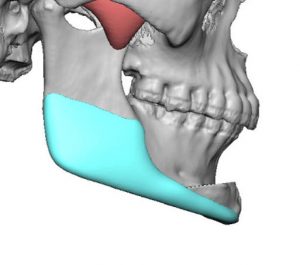 A :In answer to his jawline augmentation questions:
1) A sliding genioplasty can be combined with a single piece custom jawline implant.
2) You make the exact movements of the chin on the scan and then design a jawline implant around it. It is a not uncommon combination.
3) I would separate them by at least 6 weeks.
Dr. Barry Eppley
Indianapolis, Indiana
Q: Dr. Eppley, I hope this email finds you well. I am interested in a non-custom chin implant of about 7.5mm, or whichever size you would recommend for my face. I also have a bit of asymmetry where my chin skews toward the left and is especially visible from the front, which I’m also hoping to correct. Based on these details and the photos attached what do you recommend?
A: Thank you for your inquiry and sending your pictures. I would probably use a Mandibular Glove style chin implant of which the size options are either 6.0 or 8.0mm. When it comes to the asymmetry all that can be done with a standard chin implant is to deliberately shift it more to the right…which may lessen the asymmetry. How much to shift it to the right would depend on assessing a panorex x-ray and determining preop how much the central point of the chin is deviated to the left.
Dr. Barry Eppley
Indianapolis, Indiana
Q: Dr. Eppley, Are there any risks to a genioplasty revision not present in the original procedure (or risks that rise when you do a revision, versus the original)? I.e.: mentalis sag, infection, step off
- About how many secondary genioplasties have you done? (can be in the last few years, or whichever time period, but let me know which one you are using). When was the most recent secondary genioplasty you did?
- In your patients who undergo secondary genioplasty: has anyone ever experienced complications, and if so what kind? Have you ever had issues removing the original hardware?
- Does secondary genioplasty become more difficult to perform/get good outcomes from the further along post-op you are from the original procedure? (maybe because bone grows around the hardware, for ex.). How far along post-op are secondary genioplasty patients, usually?
- is it riskier/less risky to do a submental incision, versus intraoral?
Thank you!
A: In answer to your secondary genioplasty questions:
1) The risks are identical to the first genioplasty.
2) I so bout 10 to 12 secondary genioplasties a year.
3) Unless bicortical screws are used for fixation removal of existing plates and screws is not a problem.
4) Secondary genioplasties are done weeks to years after the original procedure. It is obviously easier to at weeks after surgery rather years but they can be successfully done in the short or long-term.
5) You can not do a sliding genioplasty through a submental skin incision….unless the goal was a reduction and not additional forward bone movement.
Dr. Barry Eppley
Indianapolis, Indiana
Q: Dr. Eppley, Hi my 14 year old son has a great complex.
He has uncorrected brachiocephaly. The pediatricians told us that it would correct itself but it did not.
At what age could I place the 3D implant?
A: Once past puberty I think it could be done anytime that the patient feels that it is aesthetically bothersome.
Dr. Barry Eppley
Indianapolis, Indiana
Q: Dr. Eppley,Thank you for getting back to me. I truly appreciate your team’s time, as I know that Dr. Eppley is renowned in his field and ahead of the curve. I have one last question for him, so that I can consider my options and then decide which one I want to schedule a consultation for. My question is: Is it possible to do a bone reduction by itself, without doing a temporal reduction, or is it necessary to do the temporal reduction first, to get to the bone?
A: When it comes to temporal reduction, if the intent is to reduce the width or convexity of the side of the head, the most significant effect come from muscle removal and also can be done in a scarless manner from an incision placed behind the ear. If one wants to do temporal bone reduction this requires an incision up on the side of the head. That more visible scar tradeoff and the negligible effect that temporal bone reduction has due to its thinness (1 to 2mms only) is why temporal bone reduction by itself has little benefit and is not usually done as a standalone procedure or before muscle removal is done. This doesn’t mean it can’t be done but is not an effective head width reduction technique in my experience.
Dr. Barry Eppley
Indianapolis, Indiana
Q: Dr. Eppley, I have egg shaped eyes and I would like a more almond shaped kind of look sorta like Megan Fox’s eyes. I would just like for my eyes to be smaller instead of big and I was wondering if that was a thing or not. Also do you guys do the cat eye/fox eye lift ? My last and final question is am I eligible for a lip reduction I have big lips and I would like them super small.
A:The main reason you have ‘big’ eyes is that the bone around the eyes is not well developed, thus the eyeballs stick out more. (known as pseudoexophthalmos) No form of eye corner or eyelid reshaping will work in this situation because of the lack of adequate periorbital bone structures. As for the lips, while they can be made smaller they can not be made ‘super small.
Dr. Barry Eppley
Indianapolis, Indiana
Q: Dr. Eppley, I am a patient who would like to inquire about reversal otoplasty surgery for over-corrected ears. I have attached some photographs.
I had otoplasty 10 years ago, and I regret it. At the time I was young and insecure about my appearance, but have since come to the opinion that my original ears, although they stuck out a bit, were suited to my face.
Unfortunately my ears seem to have been operated on badly – they are now harshly shaped and too close to my head, especially the left one. They are also different to each other, one is big and one is small, and the right ear has a sharp ridge of cartilage on the anti helix.
I am not looking for perfection, and know it is not possible after a failed surgery. However, I would like, if possible, to regain a more natural look – with the mid to upper part of my ears to come outwards a bit more – so that there is a more rounded appearance from face on. And for the ear shapes to match each other better.
I hope this is enough information and the photos are suitable, I’d really appreciate your thoughts on my situation. Also an estimate to the cost of this type of surgery would be helpful.
Many thanks for your time,
A: The reason your ears were over corrected is that you had the wrong otoplasty procedure. You had a well defined antihelical fold originally and the proper technique was a conchal setback rather than antihelical fold sutures. Now the outer helical rim is pulled behind the antihelical fold. For a reverse otoplasty the antihelical folds need to be released and an interpositional cartilage graft placed. You are correct in that they still won’t be perfect but they will look better.
Dr. Barry Eppley
Indianapolis, Indiana
Q: Dr. Eppley, I am very very stressed about a situation i am confronted with. I have put medpor jaw angle implants actually and i don’t like the way it looks on my face and i would like to replace them.
However I read in several web sites that it’s impossible to replace, others say possible but difficult, i m very scared about it, am i obliged to keep them all my Life ? What solution can i havé ?
Thank you doctor
A: They can be safely removed and/or replaced. I have done it many times.
Dr. Barry Eppley
Indianapolis, Indiana
Q: Dr. Eppley, My wife is due to have breast enlargement surgery done but, because of Covid 19, her surgeon has put it back until April/May 2021. My wife really wants 1500cc (Saline), but in your country, we only do 800/900cc. Her surgeon has asked us, if we can find a manufacture or practice that would do a 1500cc saline bag (empty) and she would be happy to fill it. Would this be possible, and could we purchase them from you if possible?
Thank you
A:I am not an implant manufacturer or distributor. But if it is saline breast implants you take an 800cc implant and overfill it to 1500cc…if the tissue stretch will permit that amount of volume expansion n a first time breast augmentation patient. This is how it is commonly done I would assume your surgeon knows this information.
Dr. Barry Eppley
Indianapolis, Indiana
Q: Dr. Eppley, in the past I consulted with you regarding custom facial implants. We agreed I should wait until after my jaw surgery to have them done.
I am now 3 months from my jaw surgery and had 2 questions.
1.How long should i wait for maximum saftey after the jaw surgery and placing the implants?
2. Could the add pressure from the implant increase the risk of jaw relapse from the surgery?
3. Should the plates be taken out if i only need angle of the jaw implants.
A:I answer to your post orthognathic surgery questions:
1) I would wait a full 6 months after your orthognathic surgery to allow for full bony healing and any settling of your result.
2) Jaw angle implants may cause some bone imprinting and/or bony overgrowth but not jaw relapse.
3) No plates need to be removed for the placement of jaw angle or jawline implants.
Dr. Barry Eppley
Indianapolis, Indiana
Q: Dr. Eppley, a while ago I had asked you about cheekbone surgery and expressed the concern about sagging. After some time I am now thinking if it could be an option for me to do the cheekbones surgery to reduce the width and then subsequently get cheek implants in order to take care of the sagging and any loss of frontal cheek projection, if it occurs. However I still came across a couple of people telling me that ‘some other people they contacted’ did not get any improvement in sagging despite getting a cheek implant. I wanted to confirm from you if this has been your experience or this has come under your knowledge. I am willing to take the long road of getting cheekbone reduction and then cheek implants to do away with their portruding width, but I want to know if it is true that even getting implants afterwards the reduction does not do away with the sagging.
Also, I won’t like implants exactly where I get the cheekbones reduced, since then it would be of no meaning. I want to reduce the cheekbone width, but maintain the projection and do away with the sagging with an implant on the front later. Please let me know your insights and guide me one more time, I’d be really grateful, thank you!
A: Like all types of upper midface implants, their lifting effects are limited and are related to their size and placement location. The midface implants that are most likely to. have any lifting effect are those that are placed through a lower eyelid incision where the cheek tissues are lifted on top of them during closure. It is a fallacious concept that any type of cheek implant placed intraorally would have a lifting effect unless they were massive in size.
Dr. Barry Eppley
Indianapolis, Indiana
Q: Dr. Eppley, “Concerning the implant design process, glad to see previous implants are helpful to anticipate results, would pictures before my implants be helpful also? Its a few years/few pounds back admittedly.
I see 2 design rounds are built into the process, how does someone accurately give feedback on a 3D model knowing its under soft tissue? Is there a way to include corresponding images of my current face and implants so I can toggle between the differences of the new implant and what the new implant improves upon? That would be the best for me to visualize, would be pretty important for me to understand.”
A: In answer to your custom facial implant questions:
1) Pre-design imaging is always done to set the patient’s aesthetic goals. You have to know what you are aiming for when making an implant design.
2) 3D implant designing is not an exact science as no one can accurately predict what will or will not show through the overlying soft tissues. It is NOT done by making a design and then painting the soft tissues over them to see what it will look like as that technology does not yet exist. That would be invaluable if it did exist and would take out all of the guess work and uncertainties of the process.
Dr. Barry Eppley
Indianapolis, Indiana
Q: Dr. Eppley, Came across your site after seeing the mouth widening procedure you perform. I’ve always felt that my smile/lips are very narrow [and small], accentuated by a long face shape.
I’m interested in having this procedure to widen them, as well as additional lip augmentations to improve the overall look and size.
Additionally, I’d be interested in face & jawline lipo.
Would love to hear your opinions on the above
A: Mouth widening procedures are effective but have a high incidence of the need for scar revision as the mouth corners are exquisitely sensitive to surgical manipulation. The rest of the lips far much better when it comes scarring. I don’t like to combine mouth widening with other lip procedure unless it is a lip procedure that does not directly manipulate the lip vermilion.
It would be hard to imagine with your lean face that facial or jawline liposuction would provide much aesthetic benefit.
Dr. Barry Eppley
Indianapolis, Indiana
Q: Dr. Eppley, I want to remove Medpor jaw angle implants. I would like to know if the masseter muscle is automatically injured and disrupted ? For the aestethic aspect what is the consequence of this disruption ? Bulge around the angle ? Or is it just functional problem ? Thank you
A: In answer to your questions about the removal of Medpor jaw angle implants:
1) There is a real risk of masseter muscle disruption with their removal due to the tissue ingrowth of the muscle. This does not mean that it always happens but it is not an insignificant risk.
2) Masseter muscle dehiscence presents an aesthetic issue (contour deformity) not a functional one.
3) The contour deformity is a triangular soft tissue depression of various sizes based on the amount of lack of muscle coverage over the bony angle.
Dr. Barry Eppley
Indianapolis, Indiana
Q: Dr. Eppley I would like to place Medpor implants for customized cheekbones (64x19x7), because I want a significant increase in cheeks, but I am afraid of the risk of infections so I wonder would it be better to choose implants silicone, but I’m afraid that they will move because I lead a very active life. So could you tell me which type of implant is the least likely to become infected over time and which is the least likely to move.
Thank you.
A: The use of standard implants for customized cheek augmentation would not be considered truly custom as they are standard implants. Before considering an implant material the first question is what is the aesthetic cheek augmentation goals and what shape and size of implant can best achieve them. Then and only then does the consideration of implant material become relevant.
With proper technique and screw fixation the risks of migration and infection are not really different between the two materials. What really counts is which material can provide the best chance of a successful aesthetic result… and….how easy or hard is it going to be if a need for revision and/or removal is needed in the future. (which is a 20% to 30% risk in bilateral facial implant surgery)
Dr. Barry Eppley
Indianapolis, Indiana
Q: Dr. Eppley, I have just discovered your clinic, I am delighted because I have long wondered if it is possible to have implants on the forehead as well as the skull, in order to have the upper face wider and rounder as women with big forehead often say are more attractive! That’s why I come to you because I’m interested in this intervention. Thank you very much
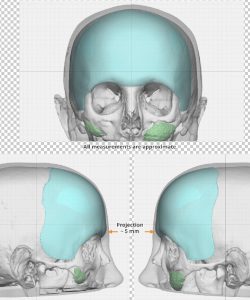 A: Thank you for your inquiry. Let’s start out by first determining what your aesthetic forehead/upper facial third goals by sending some pictures so I can computer imaging of them. I assume by your description that you are referring to the type of female forehead-temporal-skull augmentation as in the attached implant design image from a female who has undergone what you have described as your aesthetic goals.
Dr. Barry Eppley
Indianapolis, Indiana
Q: Dr. Eppley, Hi my 14 year old son has a great complex.
He has uncorrected brachiocephaly. The pediatricians told us that it would correct itself but it did not.
At what age could I place the 3D implant?
A: Once past puberty I think it could be done anytime that the patient feels that it is aesthetically bothersome.
Dr. Barry Eppley
Indianapolis, Indiana
Q: Dr. Eppley, Will I need to replace at some point my custom facial implants? How long do they usually last?
A: The only aesthetic facial or body implant that a limited lifespan and would need to be replaced are breast implants which is gel silicone placed into a containment bag whose integrity will be eventually compromised. All other face and body implants are made of solid silicone material that never needs to be replaced due to device failure/breakdown. It only changes physical form at 375 degrees F.
Dr. Barry Eppley
Indianapolis, Indiana
Q: Dr. Eppley, Below are some images taken today of an otoplasty I had last week.
As you can see, the ears have been “corrected” quite strongly, and I would like a more natural look.
(I am aware that with time the ears will distance somewhat from the head but am concerned that they’ve been “over corrected”)
Would it be possible to arrange a consultation at the earliest available opportunity to see if your surgery could partially reverse the overcorrection.
A:Thank you for your inquiry and sending your pictures,. I would not disagree with your concerns and the best time to manage those concerns is early when the otoplasty sutures can be released or redone…which would avoid a graft which is needed later when the cartilage memory has gone. My experience has been that the concerns you see now do not change later as the amount of relaxation is very minimal. I would assume this is something your surgeon would be willing to do now.
Dr. Barry Eppley
Indianapolis, Indiana
Q: Dr. Eppley, I am just inquiring around volume reduction/fat removal of the upper mouth region (the mustache area for men). Mine is somewhat protruding/convex and I have had to resort to facial hair in order to reduce the effects of it. In a classic sense, a concave upper mouth is more aesthetically pleasing and enhances the shape of the lips.
Are there any methods in reducing this area such as lipo extraction or surgery?
I noticed your response to this question in realself and thought I would contact you. I have submitted a photo for assessment.
Very much appreciate your thoughts.
A: There is no surgical procedure to reduce fullness in the upper lip/upper mouth area. Fat extraction can be done to the sides of the mouth (perioral region) but not at the upper lip area.
Dr. Barry Eppley
Indianapolis, Indiana
Q: Dr. Eppley, I have some questions regarding eyebrow lowering through tissue expander. My eyebrows sit naturally too high on my face, which give me a feminine look. I know that Botox can lower them but not to the extent that I want, I think. My questions are:
1. Do you offer this procedure?
2. Will the expander be located right above my eyebrows, in the middle of my forehead or near my hairline?
3. While using the expander, will my appearance be too unsettling, kind of like if I have some sort of tumor?
4. How long would I have to use the expander? I know it’s difficult to say exactly, but do you think it would be longer than one month or longer than two months?
Thanks in advance.
A: The concept of lowering the brow position by tissue expansion is a theoretically sound one but has several caveats to it:
1) Short term tissue expansion will not work as all the expanded tissues will quickly retract from when they came. Short term tissue expansion would only work if a physical block (brow bone implant) was placed to prevent the tissue from shrinking back up.
2) It takes long term tissue expansion (3 to 6 months) to eliminate tissue recoil….which would be socially unsettling/unacceptable to go through.
3) The placement of the tissue expander always work best when it is closest to the tissue site that needs expanding.
Dr. Barry Eppley
Indianapolis, Indiana
Q: Dr. Eppley, I got the opportunity to speak with several of your past patients who were referred me to last week. It was a great experience and I feel confident that I wish to move to the next step. I have two final questions for Dr. Eppley that emerged from these discussions – could you pass them along to him when you get a chance?
1. Since my cheek implants will saddle the lower orbital rims, is it possible that they can be placed intra-orally? Or do you think that these will need to be placed through the eyelid?
2. In Dr. Eppley’s experience, is doing both the jaw implant and cheek implants in a single procedure too large of an endeavor for most patients? After hearing about the extent of the swelling from past patients, I’m trying to decide between the benefits of doing both in a single procedure (cost and shared recovery time) with the enormous amount of swelling that will result from two sets of implants being placed at once. Since this will be my first cosmetic procedure, does you recommend breaking this into two procedures? Or is it common for patients who do elect to receive both jaw and cheek implants to have them placed in a single surgical session?
A: In answer to your questions:
1) When the infraorbital implant saddles the infraorbital rim, it must be placed through a lower eyelid incision. Trying to do so intraorally exponentially increases the risks of infection, implant malposition and permanent infraorbital nerve dysesthesia. I learned long ago that the risk tradeoff is a very poor one. A cheek implant that has a significant infraorbital component is very different than one that doesn’t.
2) It is very common for the male patient to undergo combined jawline and cheek/infraorbital-malar implants. For those that desire both facial areas it actually would be more uncommon for these two surgeries to be separated. In the end, however, one has to do what seems comfortable as after all these are purely elective surgeries as there is no medical basis for whether they should be done in one vs two stages.
Dr. Barry Eppley
Indianapolis, Indiana
Q: Dr. Eppley, Hello doctor.Am a big fan of yours from The East. I am personally interested in the surgery that you perform as the name of temporal muscle reduction,as I am also not pleased with my wide head width.
Also there are some doctors who perform this surgery in the country where I live,they seem to be more passive about the muscles reduction it self.
Have you performed this surgery on Asian Americans as well?If so,please let me know.
Also,I would like to know what surgery I can take rather from malarplasty,as my facial width is quite wide and I dont like how low my IPD is.A selfie of my midface is attached.
I hope to hear reply from you ASAP. God bless you.
A:The location of the temporal muscle to which you have drawn is the anterior portion of the temporal muscle. Unlike the posterior temporal muscle (the muscle portion above the ears), the anterior temporal muscle can not be reduced by the same technique (total excision) and can only be reduced in a very limited amount, probably not an amount you would consider to be aesthetically effective.
For the zygomatic arch width beneath the anterior temporal muscle there is only the cheekbone reduction procedure (malarplasty) that can effectively reduce facial width.
Dr. Barry Eppley
Indianapolis, Indiana
Q: Dr. Eppley, In the last few months, my skull has changed : the back of my skull is significantly flatter than before and there is this new bump close to the neck (seems to be like an occipital bun when I google, but I have no clue). It is very painful, difficult to sleep as it hurts when I lay on my pillow. It is the first time that I found something online that is similar to what I’m experiencing. It is driving me crazy because I have constant pain on my skull. I was wondering if you had any ideas what would cause these changes to my skull. Any help would be greatly appreciated!
A:While one would think as an adult the skull shape can not change every now and then I hear from someone, like you, that it can. Why that would happen I can not say. But what I do know is that for the painful occipital bun/knob that can be reduced which does relieve associated symptoms due to the protrusion.
Dr. Barry Eppley
Indianapolis, Indiana
Q: Dr. Eppley, I have had issues with my coccyx protruding and being prominent my whole life. This is something that has been a very difficult issue for me to discuss with anyone, but I did discuss it with one of my doctors in the past and she did not seem that concerned about it. It does bother me sitting for long periods of time in chairs with no seat padding or when I am trying certain exercises that cause pressure in that area …I.e. sit-ups. I have researched this issue and have not found a lot of information about this until I came across your website. I would like to know if a dermal graft would be an option for me to alleviate this issue. It has also affected my self-esteem as well because it just doesn’t look normal. I know this was very lengthy, but I will conclude now. I am willing to travel for the chance to feel normal in that area and not have any pain. Thank you.
A: When it comes to the treatment of coccydynia, the key question is whether this is primarily due to a prominent coccygeal bony protrusion, a lack of subcutaneous fat cover/thickness (usually due to aging) or a combination of both. In my experience some bony reduction of the coccygeal bone is needed combined with a dermal-fat graft overlay/interface. In other cases a total coccygectomy is needed. A dermal-fat graft rarely is ideal by itself.
I can not speak on an informed basis about your coccygeal anatomy and needs without seeing pictures of it.
Dr. Barry Eppley
Indianapolis, Indiana
Q: Dr. Eppley, I had an orthognathic surgery of both my jaws along with mandibular angle reduction, I am positive that I want to restore my angles with implants, however I had screw removal surgery just now and my surgeon told me to wait for healing before having any other surgery at the same site, though he did not specify any particular time period. I would want to know as to how long I should wait before having implants to restore the angle. Given the covid scenario I’m definitely going to wait 6 months more for now, but should I wait upto one year as repeated surgery at the same site does increase chances of infection, and just to be safe in general. It’d be very helpful if you could tell me how long exactly I should wait, I’m willing to be as patient as necessary, just want to avoid any risks.
Also I’d like to know the price difference between standard and custom made implants (custom made to be the same size as standard ones but more accustomed for slight asymmetry). A rough idea for that would be very helpful.
A: In answer to your jaw angle implant questions:
1) From the standpoint of incisional integrity and healing, six months would be an adequate amount of time from your last surgery.
2) My assistant Camille will pass along the cost differences between standard vs custom jaw angle implants.
Dr. Barry Eppley
Indianapolis, Indiana